
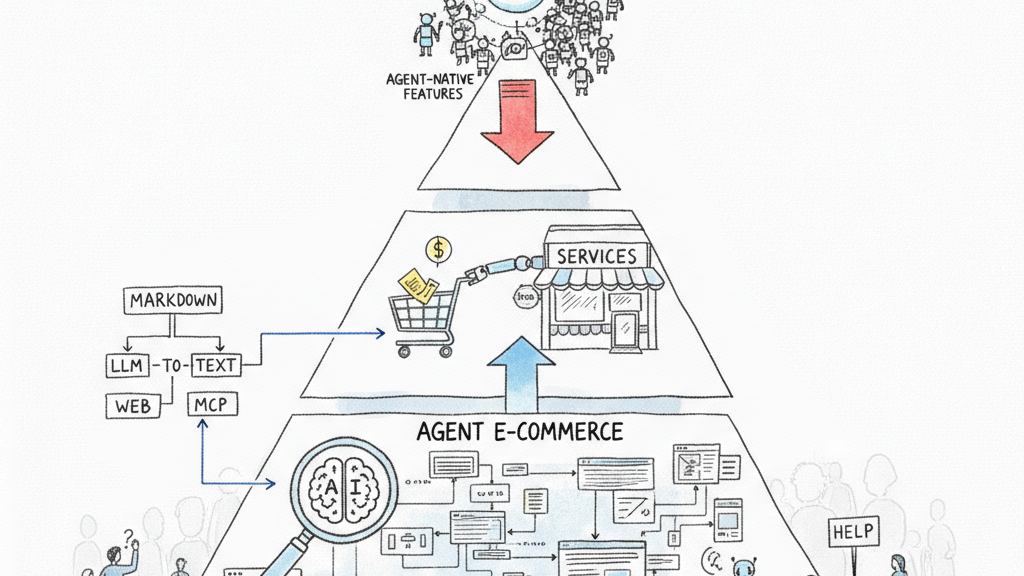
There are two different bets you can make about AI agents visiting your website, and most people collapse them into one.
The first bet is being agent-accessible. An agent can find your site, read it, and understand what you do. That means markdown versions of your content, LLM-to-text, web MCP, and the other protocols that let a model parse your pages without guessing. At a higher level it means agent e-commerce: an agent can buy and use your services, not just describe them.
The second bet is being agent-first. Here the agent isn't a visitor. It's the primary customer. You design the service for agents, and humans come second. That reordering changes what you build, because it lets you do things that never made sense for a human sitting at a screen.
The distinction matters because the two require completely different amounts of work, and mixing them up leads firms to either over-invest or freeze.
## What agent-accessible actually asks of you
Most B2B firms are not ready for an agent to read them cleanly. Your expertise is buried in PDFs, brochure copy, and pages written to impress a human skimming for two seconds. An agent doesn't skim. It parses. If your content isn't structured so a model can extract what you do, who you do it for, and how to engage you, you're invisible in a channel that's growing fast.
Being agent-accessible is the near-term job. It's concrete. Give agents a clean, machine-readable version of your content. Let them understand your services. Where it fits, let them transact. This is where the return is for most firms right now, and it's achievable without rebuilding your business.
## Agent-first is a different building
Agent-first isn't a better version of accessible. It's a different starting point.
When the agent is the primary customer, you stop designing around human patience, human screens, and human attention spans. You design around what an agent needs to complete a task. The human interface becomes the fallback, not the default.
Our Whiteboard CMS works this way. Its primary customer is an agent that builds the website. There's still a normal CMS interface, so a human can go in and change things afterward. But that's the secondary path.
And here's the opinion I'll defend: if a human has to step in and fix the agent-built site, the agent didn't do a good enough job. The human interface is a safety net, not the point. If you're relying on it, something upstream failed.
That's a high bar. It's also the honest test of whether you've actually built an agent-first product or just bolted an agent onto a human one.
## Which bet is yours
For most B2B firms, the answer is simple. Focus on being agent-accessible. That's where the near-term value is, and it's the step almost everyone still needs to take.
If you're a more technical firm, you can start thinking about agent-first products now. Not because the market is demanding them yet, but because the design questions are worth working through early. The broader agent-first mindset is still thought leadership. Treat it that way. Explore it, don't bet the company on it.
The mistake is jumping to agent-first while your existing site is unreadable to the agents already arriving. Get accessible first. Earn the right to think about first.
## The connection people miss
Here's what ties this back to something you already control: your content.
AI search now favors cited expert content over ads and brochure copy. Buyers ask an AI tool a question, and the tool answers with sources. If your expertise isn't published in a form an agent can read and cite, you don't exist in that answer. Agent-accessible isn't only about protocols. It's about having something worth extracting in the first place.
That's the harder half. The protocols are a solved engineering problem. The content — the actual expertise your firm wins clients on — usually isn't published anywhere an agent can find it. It lives in your team's heads and in client conversations.
So the practical order is: get your expertise out of people's heads and into readable, structured, citable content. Then make sure agents can access it. Then, if you're technical enough, start asking what an agent-first version of your service would look like.
Most firms are three steps behind where they think they are. Being agent-accessible sounds advanced. It isn't. It's the floor.