
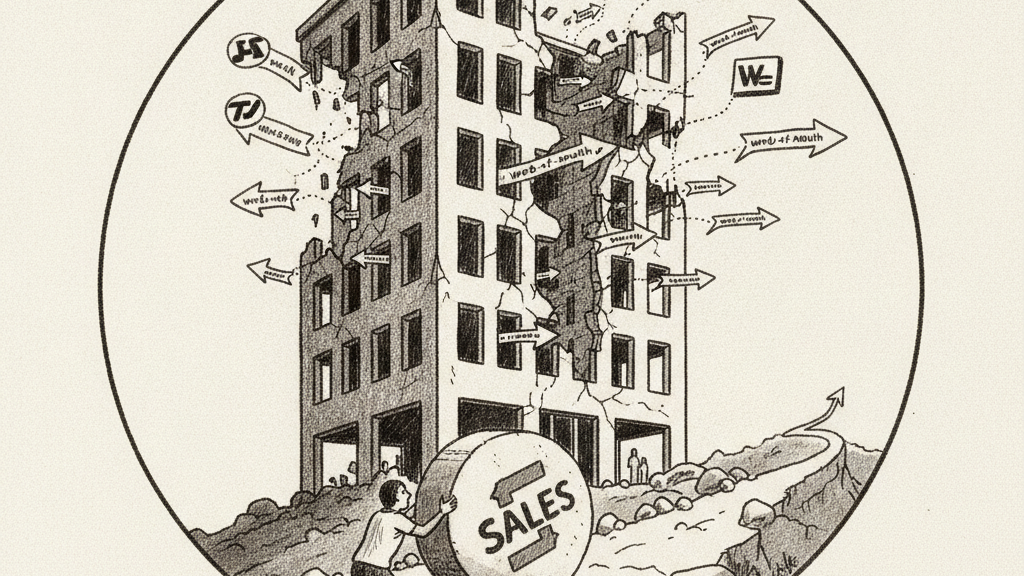
Cisco called us. We didn't pitch them. Someone told them Energized Work was the best, so they picked up the phone and said they wanted to work with us. I agree with that sentiment. At Energized Work I had the pleasure of working with some of the best software engineers in the word.
That kind of thing, a global brand contacting us based on a referral, happened more than once. It felt like proof we had cracked something.
It was actually the problem.
When your business runs on word-of-mouth, you don't control demand. You receive it. A great year arrives because three clients happened to recommend you at the same time. A bad year arrives for reasons you can't see and can't fix. You have no lever to pull. You just wait and hope the phone rings.
One bad year is all it took. Energized Work didn't fail because the work was weak. It failed because the pipeline was invisible, and when it dried up there was nothing underneath it.
## Referrals feel like a strategy. They aren't.
Every agency founder I know tells the referral story with pride. Best client we ever had, came through a recommendation, never spent a penny on marketing. I told that story too.
The flattering version hides the truth. You cannot scale something you cannot predict. You cannot forecast revenue on goodwill. And you cannot decide, in a quiet quarter, to simply generate more referrals. They arrive on their own schedule, not yours.
So what's the alternative? For most service businesses the default answer is direct sales. I've watched that play out. In a services business the sales cycle is long, the cost is high, and you're asking strangers to trust you before they've seen how you think. It's a grind, and it rarely fits the margins of a small expert-led firm.
## We tried content. We were bad at it.
The obvious move was to publish what we knew. They called it "Thought Leadership" back then. We had genuine expertise. We had opinions. On paper, content should have worked.
It didn't, and the reason was boring. We had no rhythm. Simon, my business partner was a prolific writer, but no one else participated, and nobody shared them. There was no schedule, no habit, no system that survived a busy week. The moment client work got heavy, the writing stopped. Which was always.
That's the part people underestimate. The hard bit of content isn't ideas or talent. It's discipline. Doing it every week when nobody is forcing you to, when the deadline is self-imposed and easy to skip. Experts are busy. Writing feels like a chore that can wait. So it waits forever.
## The fix is a habit, not a tool
If I were building the answer to my own failure, it would look like this. Interview the experts. Don't ask them to write.
That's the idea behind WhiteBoar. Once a week, it sends a few questions over WhatsApp. The expert answers by voice or text in under fifteen minutes. No login. No new software. No content calendar to maintain. Then AI turns those raw answers into articles and LinkedIn posts in that person's voice, a human approves them, and they get published under the expert's own name.
The human element is the whole point. The interview is what makes it real. The output isn't generic AI filler scraped from the internet. It's grounded in something that actually happened. Nothing goes out without approval.
And here's the shift I couldn't make at Energized Work: it only takes one person to keep it running. A founder or a coordinator reviews and approves. You don't need a marketing team. You need one reviewer and a weekly habit that doesn't depend on anyone remembering to do it.
## Why this matters more now than it did then
When my agency was alive, the game was Google and referrals. That's changing. Buyers increasingly ask AI tools their questions instead of typing them into a search bar. Those engines favour cited expert content over ads and brochure copy. LinkedIn's algorithm pushes individual profiles harder than company pages. In both cases the winner is the same: a named person who publishes consistently.
Company pages lose, paid ads get ignored, but published experts get found.
If your firm wins work through expertise and trust, that expertise is already your best salesperson. Right now it's probably trapped in people's heads, spoken in meetings, and never written down. The task isn't to become a media company. It's to make the knowledge you already have show up where buyers are looking, week after week, without anyone having to chase it.